

When staying in Excel is the right call
By Zack Pemberton · · 4 min read
 By Zack Pemberton · · 4 min read
If your whole operation still runs out of Excel, you have probably had the thought that you are behind. That everyone else has moved on to real software, and you are the one still typing into a spreadsheet like it is 2004.
You are not behind. Excel is not a waiting room you sit in until you can afford the real thing. For most businesses, it is the actual tool for the actual job you need done first, which is figuring out what you even need to track.
That is worth saying plainly, because almost nobody selling data work says it. The honest version is this: you stay in Excel to build your foundation. You leave Excel, for real reporting or a database, when that foundation is done and you are ready to formalize it. You do not leave because the spreadsheet finally broke. Plenty of businesses leave too early, build something rigid around numbers they have not actually figured out yet, and end up rebuilding it in a year anyway.
Building the foundation looks like a specific set of habits, not a specific piece of software:
Knowing what you are actually trying to track, not just what is easy to record. Gathering more than you think you need at first, because you do not know yet which of it matters. Narrowing what you actually watch as you go, once you find out, not what you keep collecting. Tracking the same thing the same way, week after week, instead of inventing a new column every time something changes. And underneath all of it, asking yourself the plain question over and over: what do I really need to know here?
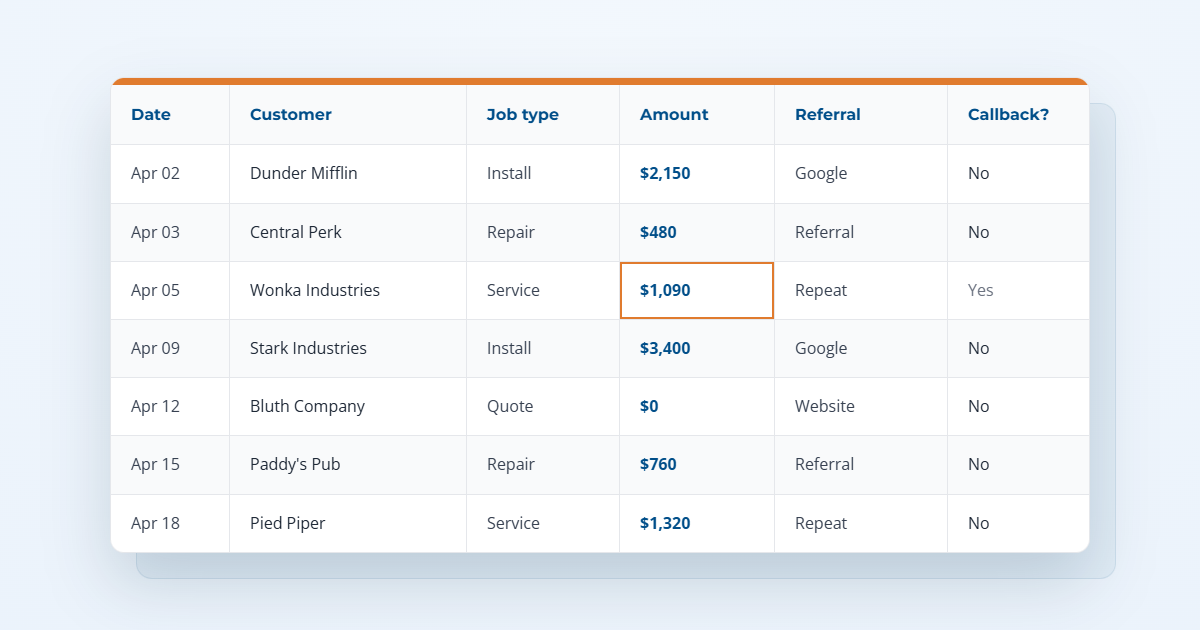
Here is roughly what that looks like on paper.
- Date
- Customer
- Job type
- Amount
- Referral source
- Crew
- Weather
- Materials used
- Time started
- Time finished
- Callback?
- Notes
- Date
- Customer
- Job type
- Amount
- Referral source
- Callback?
Half those early columns stop being something you check every week, not because collecting them was wasted effort, but because you cannot know in month one which ones you will actually use in month six. That narrowing, of attention, not the data itself, is the foundation work. You cannot skip to the short list without going through the long one first, unless someone else has already done that discovery for a business exactly like yours, which is rare.
There is a second, separate judgment call buried in all this, and it is the one I actually make with people, not the one about database readiness. It is whether someone needs friendly advice or needs something built. Those are very different conversations, and a lot of people come in thinking they need the second when they actually just need the first.
Say you are one person, writing notes on a legal pad during the day and typing them into Excel at night. You do not need a build. You need someone to tell you that you can record a voice memo or snap a photo of the pad and have it turned into rows in your spreadsheet automatically, so you stop doing data entry twice. That is a five-minute conversation, not an engagement.
A build is a different animal. It is when the foundation work is genuinely done, the structure is real, and what you actually need is for that structure to run itself instead of you touching every cell by hand.
One exception, because it is a real one and not a hedge: a software company usually should not start here at all. When the product is the data, you build the database from day one, because there is no version of "figure it out in a spreadsheet first" that makes sense when the thing you are building is inherently structured, at scale, from the start. That is the exception that proves the rule rather than breaking it. Everyone else is doing discovery work, whether they call it that or not.
So the honest question is not "am I still stuck in Excel." It is: what have you actually learned about what matters to this business, from the tracking you have already been doing?