

Why your best service might be your worst-paying job
By Zack Pemberton · · 3 min read
 By Zack Pemberton · · 3 min read

Ask any home service owner what a job costs and they will pull up parts pricing before you finish the question. Fittings, capacitors, filters, whatever the trade calls for, it is all itemized, marked up, and baked into the invoice. That part of the business runs tight.
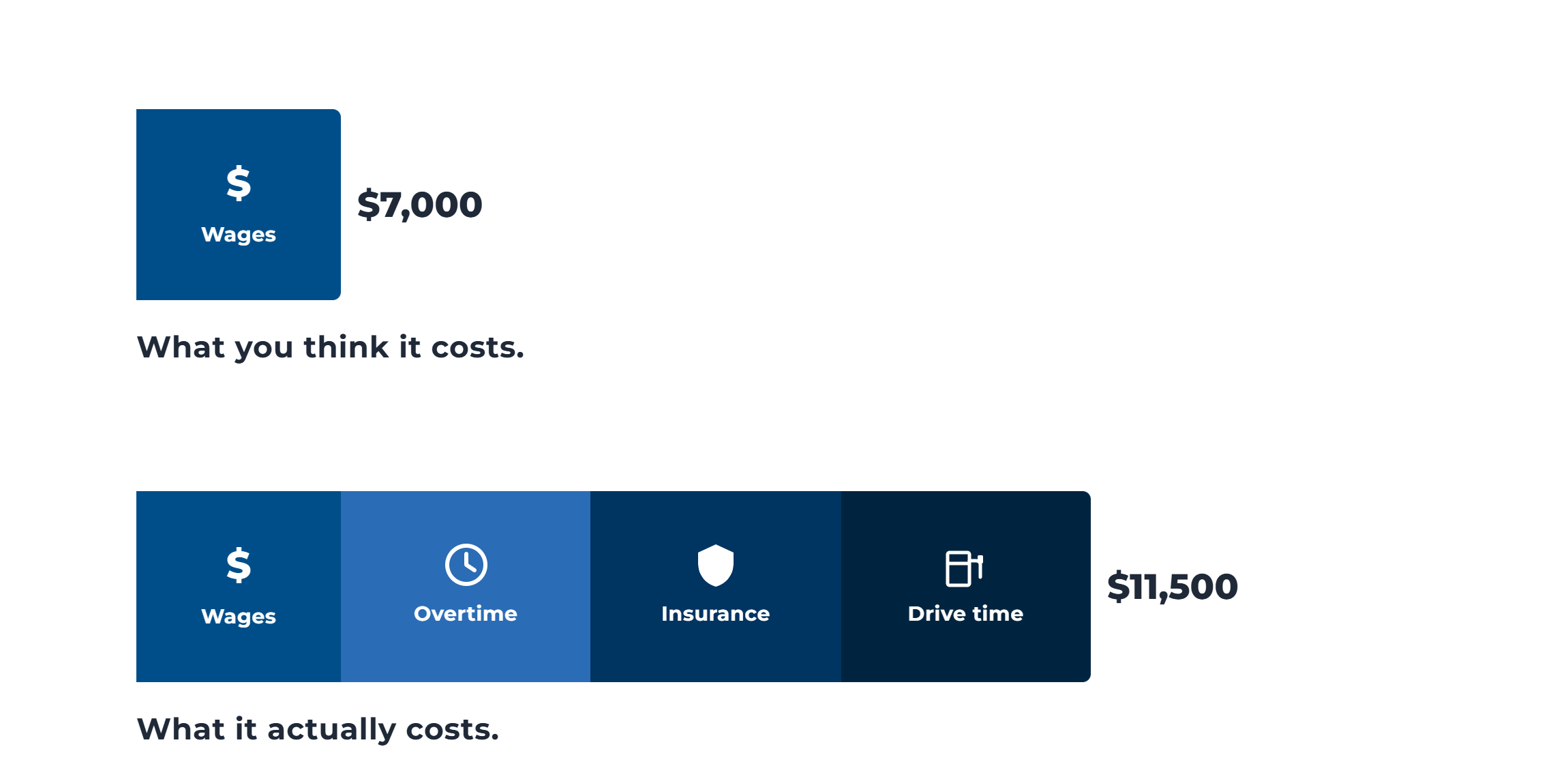
Ask the same owner what an hour of their own crew's time actually costs. You usually get the hourly wage and a shrug. Not the overtime that crept in on a busy week. Not the insurance and workers' comp riding along with every truck. Not the twenty minutes between stops that never shows up on an invoice but absolutely shows up on a paycheck.
Materials get tracked like a science. Labor gets guessed at.
The service that looks like your best seller
This is where it gets uncomfortable. The job that hides this problem best is usually the one you would point to as proof the business is working. High volume, easy to sell, easy to schedule, customers love it. A maintenance plan. A quick diagnostic visit. A tune-up. Price it low enough and it fills the calendar fast.
Illustrative example: say that service runs $150 a visit, and your crew does eighty of them a month. That is $12,000 in revenue from something that barely takes a sales pitch. Feels like the easiest money in the business.
Now load in what that hour actually costs. Not just the wage on the paycheck, but overtime, insurance, and the drive time between stops. The same eighty visits can turn a service you would bet on into one that is barely clearing anything before overhead, once everything is counted. Run your own numbers below and see where yours lands.
What "hours worked" and "hours cost" don't have in common
Here is the part that catches people. A tech can log eight honest hours on the clock, and the business can still be underwater on that day. The number you should be comparing to your price is not the wage. It is the wage plus everything riding along with it: overtime on a week that ran long, the insurance premium that climbs with every truck on the road, the drive time between stops.
That drive time is real. Real gas, real wear on the vehicle. But nobody is paying for the trip, only the work, so it never gets billed to a customer.
None of that shows up on the invoice. All of it shows up in March, when you are staring at a P&L wondering why your busiest service is not paying like it should.
It doesn't mean the service is bad
A thin number like that does not mean drop the service. It means you might not actually know what it costs you to deliver. Maybe the price needs to move. Maybe that job type needs to go to your fastest crew instead of whoever is free. Maybe it's fine and the math was just never run. You won't know until you run it.
Which service in your lineup have you never actually calculated the labor cost on? The one you are most proud of, or the one you've just always assumed was fine?