

Every permit in Greenville is public. Your competitor is checking it before you are.
By Zack Pemberton · · 6 min read
 By Zack Pemberton · · 6 min read
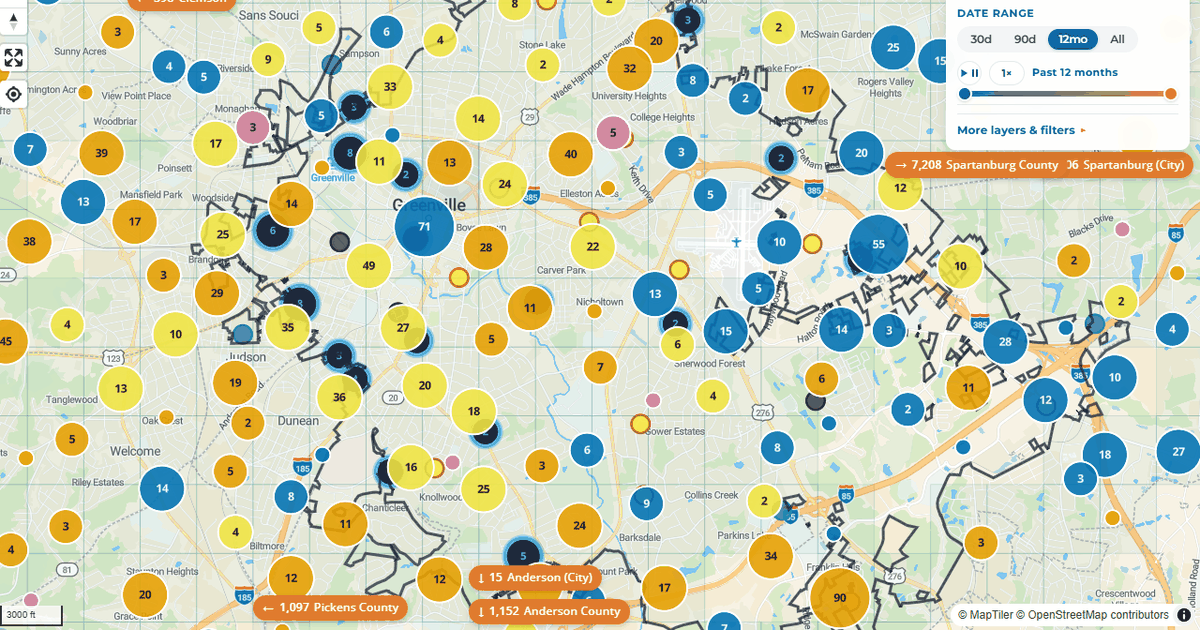
Every building permit issued in the City of Greenville is public record. You can look any of them up right now, for free, without asking anyone's permission.
So the real question is not whether the information is out there. It is whether you are the one reading it, or the competitor who already bid the job that you did not even know was happening.
A while back a landscaper came to us with a question that sent me down a hole I still have not fully climbed out of. She wanted a way to hear about new townhome subdivisions before they got built. Not after, when the streets are paved and every other landscaper in town can see them too. Before.
It makes sense when you think about the order things happen in. A building has to exist before anyone decides what goes around it. The grading, irrigation, and lawn all get settled late. So if you wait until you can see the neighborhood, the work is already spoken for. The first real sign that a subdivision is coming is not the dirt moving. It is the permit, sometimes months ahead. And it runs the other way too: a brand new house sitting on bare dirt is a landscaping job waiting to happen, and the permit is the thing that tells you it is there.
Now picture a different trade with the same problem. Say you install home theaters, or low-voltage wiring, or lighting. Your window is not early and it is not late; it is the middle, while the walls are still open. Once the drywall goes up, the moment you needed is sealed inside it. A permit tells you a build is underway while you can still get in the door. Same goes for the plumber and the HVAC crew bidding the rough-in. Different trade, same clock.
Here is roughly how a permit moves. Someone files it, the office reviews it, and at some point it gets issued. After that some offices close it out and some leave it open more or less forever. Most places will not even show you a permit until it is at least partway approved. So you are not catching the idea the day someone dreams it up. You are catching it the day it becomes real, which is still a long way ahead of the person who finds out when the sign goes up in the yard.
So the data is public. Why doesn't every contractor in town already live in it? Because public and usable are two very different words.
When we set out to pull permits across the Upstate, the trouble was never getting the records. It was that no two offices publish them the same way. We found eleven permit offices we could actually pull from. To find those eleven, we checked almost three hundred jurisdictions, and ninety-one of them still run entirely on paper: no website, no download, a filing cabinet, and a front desk. If you want the receipts on that, we wrote up the full jurisdiction-by-jurisdiction audit.
Start with what a permit is even called. One office files a new apartment complex as commercial. The office a county over files the identical building as residential. Here is how three different offices actually recorded the same kind of building, and what else landed in the same bucket:
| Project | Filed as | Value |
|---|---|---|
| Apartment Building 1 | New Building - Commercial | $1,462,589 |
| Apartment Building 2 | New Building - Commercial | $2,800,339 |
| PSI Headquarters Building | New Building - Commercial | $4,291,110 |
| Project | Filed as | Value |
|---|---|---|
| 48-unit apartment complex | New Multi-Family Apartments | $9.7M |
| Multi-family apartment building | Residential, New Five or More Family | $10.6M |
Same building. Opposite category. So if you sort those permits for commercial jobs, you just skipped the apartment complexes. Sort for residential and you skip them the other way. Now do that across eleven offices that each invented their own vocabulary. The same records show up under 448 different permit names across the Upstate. We boil them down to twelve, and "just filter the permits" stops sounding so simple.
And that assumes the words are even spelled right. Here is the box where one office's clerk types what kind of permit it is, exactly as it reaches us:
Six spellings of one word. The same office's status field says "ISSUED" more than a thousand times, "isued" once, and "IISUED" once. Tell a computer to go find every issued building permit and it quietly drops the two somebody fat-fingered. Now multiply that by every hand-typed field in every office.
Then there is the number that actually tells you whether a job is worth a phone call: the dollar value. Greer has not once published a permit with a dollar value attached. Oconee County leaves it blank close to three-quarters of the time. The one figure you would sort on, simply not there.
None of this is one bad county having a rough year. This is the normal state of public permit data. The baseline.
The City of Greenville is one of the exceptions. It hands its records over in a clean, structured feed, which is the only reason we could turn the whole city into a map anyone can open. Every building permit, planning application, and active road closure, on one screen. No login, no email, nothing to sign up for.
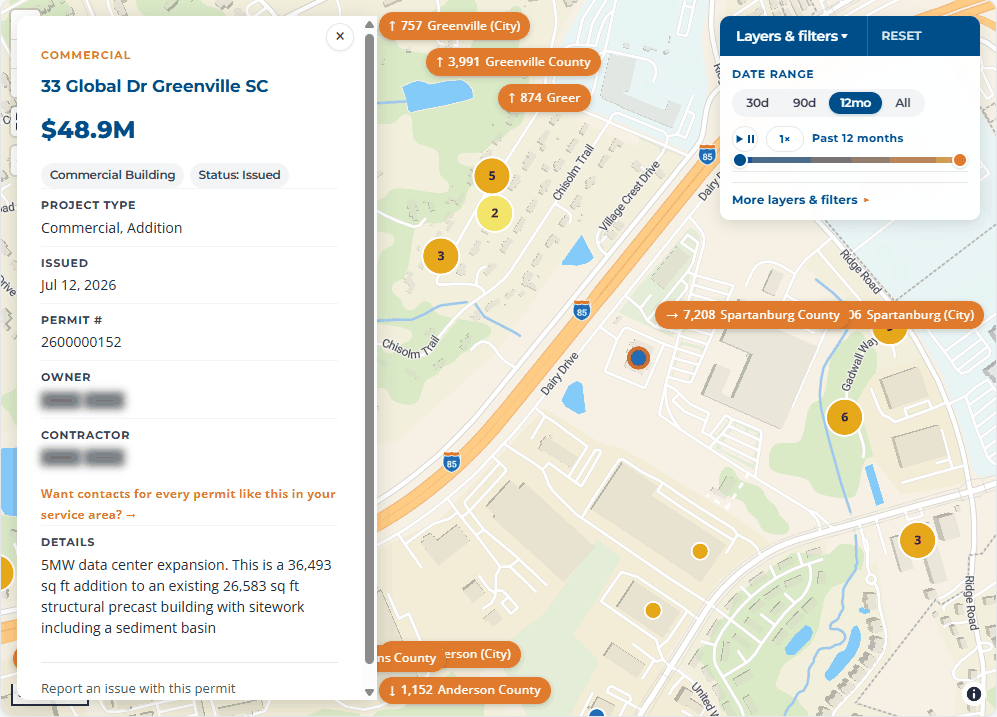
You can open it right now at pembertondata.com/map. It is honestly almost too useful to be free, but there it is, yours to poke around in. Everywhere else in the Upstate is the messy version you just read about.
One decision is worth telling you about, because it is the part we sat with the longest. The records will tell you everything. Every residential permit carries a name and an address, and we are legally allowed to republish all of it. Plenty of tools do exactly that, and you can go find sites that will cheerfully show you which of your neighbors is redoing a kitchen and who they hired. We decided not to. On our map, home permits show up only as neighborhood totals, no name, no street address. Commercial permits show in full, because a business and its building already live out in public. If you want the longer version of how we drew that line, we wrote it up.
So here is the question I would leave you with. What would change over your next few months if you knew about this work before your competitors did?